After reading Monstrosity of Christ I have been looking forward to Creston Davis’ follow-up: the exploration of the contemporary relevance of St. Paul’s thought among both radical atheists and radical theologians. Apparently, since St. Paul's ideas are engaged by several contemporary thinkers, this means he has 'a new moment'. Of course, this book is not really about St. Paul at all, but hey, which book about St. Paul ever was? This book is instead another step forward in the editor’s endeavour to think with, through, and beyond the ideas of Slavoj Zizek and John Milbank (who in this project is flanked by theological comrade in crime, Catherine Pickstock). No more.
I should say I am deeply sympathetic to Creston Davis’ project. The attempt to find ways of combining the ideas of his two former teachers might be the only response that remains true to them both. Paradoxically, one might say. Or dialectically. I believe which term you prefer comes down to what blogs you like to read (i.e. whose approval you are after).
The mere fact of having been taught by both Milbank and Zizek gives Davis a kind of street cred that not everyone can boast. This biographical fact itself suggests that, at least in Creston Davis’ head (since he has simply had to make it work somehow), Milbank’s metaxology and Zizek’s dialectics can be fruitfully combined. And indeed, it is Davis’ own contributions to the book, together with Catherine Pickstock’s wonderful reflection on the liturgy and the senses, which are (to me at least) the most interesting.
Not that Milbank and Zizek are boring, not at all. But when reading the allegedly new reflections on Paul from the two ‘ultimate fighters’ from Monstrosity, I realized that I have read most of this before. This is where the book disappoints a little. Milbank’s style is entertaining if you like the metaphysical ‘zapping’ of enemies. But the in-it-to-win-it theologian’s essay on Badiou has been available (albeit in draft form) online long before the publication of this book (which raises interesting questions regarding online and printed publishing, but that’s for another day). Zizek’s essays are as entertainingly rebellious as ever (he is that school yard bully you think is cool so long as he's not after you), but his arguments are yesterday, today and forever the same. And, hey, why not?
Now, here's the point. In his (dauntless or hopeless, I leave that to the reader) attempt to combine these two thinkers, it seems to me that Davis is, in some weird way, actually being faithful to both of them. Not that either would embrace everything he writes, as if Milbank and Zizek were a quarreling couple, who after a therapeutic session with Dr. Davis realize that they are in fact meant for each other. Not that. But simply because neither of them could be content with less than Everything. We are discussing ontology, after all. Neither Milbank nor Zizek would admit that there is anything that ultimately escapes his own ontological framework, because then they wouldn’t be doing ontology anymore. Ontology speaks of Everything, and there is no ‘outside’ space for the opponent to inhabit.
This is what makes Davis’ project seem (to me, at least, though blog wars will go on) to be the only appropriate response to the incompatibility of Milbank and Zizek. Both will fit the other into his own ‘system’ of thought rather than reject him as simply ‘outside’ it. To Milbank, then, Zizek is fundamentally a protestant assuming the possibility of a qualitative break from stale tradition and hence failing to account for human creativity as improvised participation in God’s life. To Zizek, by contrast, Milbank is fundamentally an ideologue providing a vague yet final theodicy in the face of even God’s ultimate suffering, disguised as aristocratic babble of cosmic/societal harmony. Of course dressed up in a dispute over who is ‘more Christian’, but that’s not only beside but really quite far off the point. In this sense they are really engaged in an all-or-nothing battle. But precisely for that reason, it would be inadequate to simply choose one of them. To choose one and reject the other would, in some ways at least, be to deny the all-encompassing nature of the system one chose, and allow the rejected ‘outsider’ a legitimate foothold beyond the reach of one’s categories – which would reveal one’s blind spot – which would be the end of one’s ontology.
And of course, the conflict itself can be construed in the terms of both sides. "It's harmonic difference!" "No, its dialectic constitutive contradiction!" Ad infinitum. Fun for the kids.
Davis’ clever response has been, primarily, to produce these two books, thus literally placing these two articulated universal ontologies next to one another in a shared space. Not only does this open up room for thinking about the nature of the space where such an unlikely meeting is somehow made possible, but it challenges the reader to join Davis in the effort of holding things together (without simply postulating a common enemy in liberal capitalism). Or, if you like, to deny the necessity of the violent rejection of one in favour of the other. Now, this ‘positive’ approach, I think, implicitly betrays Davis’ debt to thinkers such as William Desmond (who Milbank draws on for conceptual clarification in Monstrosity). Death and dialectics are not simply eradicated, but 'swallowed up', all St. Paul-style.
In this subtle way, Davis simultaneously kills and resurrects both of his former teachers. He also thereby ensures that he pisses off two opposing camps of devoted followers in one and the same move, which, to my mind, is probably not a bad thing. So having read both Monstrosity of Christ and Paul’s New Moment I now eagerly await a book to complete the trilogy – this time one written primarily by Creston Davis perhaps flanked by like-minded explorative thinkers who respect both Milbank and Zizek enough to neither follow nor reject either (though this is of course impossible to avoid – Dialectic! Paradox!), but rather think with them till the end, and then a bit further. Maybe that book will feature numerous footnotes with the name ‘William Desmond’ in them. I’d like that, I think.
Showing posts with label philosophy. Show all posts
15/03/2011
23/01/2011
Zidane, Serres, and the beautiful game
Being a long-time fan, some years ago I bought the film portrait of the French footballer Zinedine Zidane, by many considered one of the best individual players in the history of football. A number of cameras follow his every move on the pitch for a whole 90-minute match, some from a long distance, some focusing on his face, his whole body, or his feet, from various angles.
Watching this film is completely different from watching a TV match. On TV, the cameras follow the ball as it moves around on the pitch. It seems like something is always happening. Not so in this film. Following a single player, you realize how much each of them is not directly involved. Isolated from context, the meaning of the game is lost.
Almost 20 cameras on Zidane alone. They even have a microphone on him. Throughout the game, he doesn't say a single word. He smiles to a joking opponent, pats David Beckham's back after their team scores a goal, points a couple of times to suggest passing options for team mates - and that's it. As some film reviews said, this is the perfect portrait of the (paradoxically) lone athlete: closely observed by cameras and billions of spectators (Zidane's North-African background has made him the main football-idol of that whole region alone), yet speaking with nobody, seeing no one, hearing nothing.
Yet the loneliness only serves to bring out what one might not realize was there - the constituting relationality that carries the beautiful game
In a passage in The Five Senses, Michel Serres describes the intuitive sensations of ball games. While the description deals with hand ball and rugby, it can easily be translated into that of playing football. The fact that footballers aren't allowed to grip the ball at all, and so cannot stall its movement even the slightest (except by using the sole of their foot - a move demanding exceptional abilities, at least on higher levels), only emphasizes Serres's point.
"Usually, when the ball is passed - and it flies so quickly so as not to be intercepted - it moves from one pair of skilful hands to another; acute, vigilant glances are exchanged, often preceded by a call, word, cry, brief interjection, vowel and even a coded hand gesture. The ball runs with them, after these signals, at the same time as they do, along the network of fluctuating channels that they trace out. Suddenly the ball takes their place, all other signals are extinguished. The whole team enters a box, a dim cave, the clamour of the spectators becomes distant like the far-off seashore, the opposing team dances like a group of shadows without strength, ghosts; it is at that moment that my body positions itself at the point where the ball will pass, I throw it into the vacuum that another cherubim will fill, immediately and unquestioningly, we no longer look at each other, no longer hear each other, no longer speak to each other or call out to each other - our eyes are shut, our mouths closed, our ears blocked, we have no language, we are monads - we know, anticipate, love each other; we anticipate each other at lightning speed, we cannot go wrong, it is playing: not me or my partners but the team itself. I move to the right, I know that another player knows that I have done so, that the ball will await me. The ball is traveling so fast that it weaves between us bonds of unassailable certainty; as this certainty is seamless, the ball can travel around even more rapidly, and as it travels more rapidly it weaves...No-one who has not experienced such ecstasy can know what being together means." (p324)
Good players not only move the ball around - they adapt to the movement of the ball, the movement of other players, and the multiple forces that generate and influence all the intermingled movements - from gravity to one's knowledge of the opponent's strengths and weaknesses.
Seen one way, the ball is the most stable centre of the many movements. Its movements - together with an increasing number of restrictions - determine the game. Yet it is also the thing that moves the most itself. It is only still when there is some breach of the rules, or it goes beyond the confines of the pitch, and it must be put back into play. It has the highest speed and farthest reach of anything on the pitch. Every year new footballs are designed that move faster and further. Even when it goes off the pitch, one has had to invent rules for how to get the ball back on so the game can continue.Every decade or so, the official rules are modified so as to keep or increase the tempo of the game - 'locking' the ball is not allowed, it must move freely; the goalkeeper can only grip the ball in his hands for a limited time; he must never grip the ball with his hands when receiving it from a team mate, etc. The movement of the ball trumps all.
The best players adapt, they give way, they allow themselves to be molded, they give themselves up to the ball's dictation. Does this mean that the worship-like veneration of individual football 'idols' is a mere mass-media phenomenon - an illusion, since any player might be made good or bad by the team as a whole? Relationality and reciprocity is on the contrary fundamental both on macro- and micro levels. The skillful individual dribbler makes use of the ball's trajectory, and feigns intervention, for example by pretending to alter its course from left to right. Yet the body's dance is always adapting to the movement of the ball - or to how its movement is predicted by the opponent player. The strong individual player is the one who kenotically loses himself to the other movements, yet receives himself (as a strong player) from these. The strongest have spent daily hours turning this self-giving into embodied habits.
In many ways, the relational, the paradoxical "in-between", is therefore the central factor in football, that which constitutes all other movements. Following thinkers such as Michel Serres, we could see this as an instant (rather than image) of Reality as such. The game is hence a 'concentrated' rather than altered or 'fake' version of Reality. A dialectic between creativity and boundaries, process and static. A liturgical dance.
You can watch the whole film here
Labels:
Film,
football,
Hobbies,
Liturgy,
media,
Michel Serres,
musings,
ontology,
philosophy,
Zinedine Zidane
24/11/2010
Latour and modernity
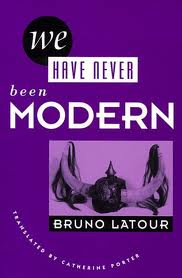
If any book has ever changed the way I think, it would be Bruno Latour's "We Have Never Been Modern". It is a complex argument with a lot of fascinating implications that philosophers are still working out.
In this book, Latour describes modernity - our contemporary way of thinking, living, and asking questions - as being founded on a particular 'constitution' or set of rules that have come to be taken for granted, but that turn out to be self-contradictory and groundless when we examine them. The reason is that we 'moderns' only think consciously about one part of the constitution at a time, and so the contradictions escape us - we believe we are actually being consistent.
Central in Latour's analysis of modernity is our attempt to separate Nature from Society. Nature stands for everything that simply is what it is, whether we would like to change it or not. Society stands for all that is human, human-made and artificial, that we might construct otherwise if we choose to. What Latour shows is that Nature and Society aren't really that easy to separate in reality, even though the moderns treat them as if they are already separate.
For example, a scientist in a laboratory claims to be seeing Nature as it is, apart from any human construction. But he can only confirm what Nature is in itself through the agreement of a community of scientists in a human-made laboratory. They construct an environment and a consensus that Nature is a particular way. This way, Nature is founded on Society. But this can be reversed. The science of Society tells us that humans can construct whatever society we like, and that this is our liberty. But in order to base her argument on something, the social scientist refers to sociological 'laws' that echo the natural 'laws' of the laboratory. Society is then ultimately founded on Nature.
We, the 'moderns', are only able to look at one of these at the time, and so we don't realize the inconsistency. In fact, Latour says, there has never actually been a clear separation between Nature and Society. But for as long as we have told ourselves that we manage to make that separation, we have remained blind to the many 'hybrid' things in the world that belie our categories. In this sense we have never been modern - for we have never actually separated Nature from Society.
Latour shows how our views of God, history, time, materiality, ideas, etc. are all connected to the modern 'constitution', and also how the questions regarding all of these are re-opened when we realize just how unsustainable is the modern way of thinking and practicing. We cannot forever keep on acting as if the separation of Nature and Society is possible, but all our modern practices are tangled up in this misconception.
After having argued that we have never been modern, Latour then has to explain what then we have actually been. In other words, he must give us an alternative way of thinking about the world. This is the basis for what has become loosely known as 'Actor-Network Theory', even though Latour himself is not too fond of that particular label.
The details of this philosophical system is a bit too complex for this post. Generally, it is used as if it simply means giving more attention to the material objects involved in human societies, but Latour's metaphysics are a bit more radical than that. While Latour's view of the world has recently been taken up by confessional atheist philosophers as a kind of 'deep' materialism, his metaphysics also invites a sacramental, trinitarian, catholic theology. In a later post, I hope to show how this is the case.
In this book, Latour describes modernity - our contemporary way of thinking, living, and asking questions - as being founded on a particular 'constitution' or set of rules that have come to be taken for granted, but that turn out to be self-contradictory and groundless when we examine them. The reason is that we 'moderns' only think consciously about one part of the constitution at a time, and so the contradictions escape us - we believe we are actually being consistent.
Central in Latour's analysis of modernity is our attempt to separate Nature from Society. Nature stands for everything that simply is what it is, whether we would like to change it or not. Society stands for all that is human, human-made and artificial, that we might construct otherwise if we choose to. What Latour shows is that Nature and Society aren't really that easy to separate in reality, even though the moderns treat them as if they are already separate.
For example, a scientist in a laboratory claims to be seeing Nature as it is, apart from any human construction. But he can only confirm what Nature is in itself through the agreement of a community of scientists in a human-made laboratory. They construct an environment and a consensus that Nature is a particular way. This way, Nature is founded on Society. But this can be reversed. The science of Society tells us that humans can construct whatever society we like, and that this is our liberty. But in order to base her argument on something, the social scientist refers to sociological 'laws' that echo the natural 'laws' of the laboratory. Society is then ultimately founded on Nature.
We, the 'moderns', are only able to look at one of these at the time, and so we don't realize the inconsistency. In fact, Latour says, there has never actually been a clear separation between Nature and Society. But for as long as we have told ourselves that we manage to make that separation, we have remained blind to the many 'hybrid' things in the world that belie our categories. In this sense we have never been modern - for we have never actually separated Nature from Society.
Latour shows how our views of God, history, time, materiality, ideas, etc. are all connected to the modern 'constitution', and also how the questions regarding all of these are re-opened when we realize just how unsustainable is the modern way of thinking and practicing. We cannot forever keep on acting as if the separation of Nature and Society is possible, but all our modern practices are tangled up in this misconception.
After having argued that we have never been modern, Latour then has to explain what then we have actually been. In other words, he must give us an alternative way of thinking about the world. This is the basis for what has become loosely known as 'Actor-Network Theory', even though Latour himself is not too fond of that particular label.
The details of this philosophical system is a bit too complex for this post. Generally, it is used as if it simply means giving more attention to the material objects involved in human societies, but Latour's metaphysics are a bit more radical than that. While Latour's view of the world has recently been taken up by confessional atheist philosophers as a kind of 'deep' materialism, his metaphysics also invites a sacramental, trinitarian, catholic theology. In a later post, I hope to show how this is the case.
Labels:
catholicism,
Latour,
modernity,
philosophy,
Readings,
sacramental
10/11/2010
Alain Badiou: an atheist reads St. Paul
The first in a series of books I have just read that somehow inspired me, is Alain Badiou's book on St.Paul's radical philosophy and politics.
Alain Badiou is one of the contemporary philosophers who despite his announced atheism is exploring Christian doctrine for resources to meet present philosophical and political challenges. In particular, he has engaged with Christian thought as it develops through the work of St. Paul. Most of Badiou's philosophy is hard to understand, since he is often demanding an advanced understanding of mathematics (in particular Cantorian set theory) from his readers. I wish...
One could of course accuse Badiou of simply trying to shape St. Paul in the image of his own philosophy. He is certainly not the only one doing that. His project is nevertheless fascinating because of how he introduces the book to his assumed atheist readers (to whom he obviously feels he has to justify his use of Christian thought at all). Badiou himself states that there are more important distinctions to make in the contemporary world than between 'religion' and philosophy.
Our contemporary world, says Badiou, is a place where there is a homogenizing universalism on the one hand, and a kind of impotent identity politics on the other. What does this mean? On one side, a globalizing market reduces all forms of life to mere numbers on a sheet of paper, drained of any specific quality. Everything can be measured (in terms of money), and compared on the same background. On the other side, there are groups seeking recognition of their 'rights' within this global order, and trying to distinguish themselves from those who do not belong to that particular group.
Badiou claims the conditions we live under are similar to the circumstances of St. Paul, and that we have much to learn from the apostle's radical break with everything around him and his construction of a new way of thinking and living the (his) truth. On the one hand, Paul was surrounded by a Roman empire (our time's global market) that enveloped all particular identities within its geographical borders and the limits of its Greek philosophy. On the other hand, he was engaging with a Jewish community (our time's identity politics and interest groups) that sought to have their particular 'rights' recognized by the Empire, while distinguishing themselves from all the other groups through certain characteristics.
These two forms of 'universalism' always go together - in fact they re-enforce each other -, and both are false to Badiou. What he sees St. Paul doing, then, is to challenge both of these at the same time. St.Paul refuses all the available categories of the world around him ('there is no Greek nor Jew, no male nor female, etc'), and constructs 'from scratch' a completely new kind of practicing community (the Church) that is universal but not homogenizing like the empire, and time/place-specific without being based on particular qualities (showing who's 'in' or 'out') like the Jewish community.
Badiou's reading of St. Paul flies in the face of what many contemporary churches seem to be practicing. Either, the church attempts to subsume everything and everyone into itself (as if it were an Empire) - or it is fighting for its 'rights' to be recognized by the State, while constantly trying to define the criteria for being 'within' and 'outside of' its fold (as if it were just another interest group). Badiou's reading suggests none of these strategies are 'Christian' in the way St. Paul describes it.
Contemporary theologians and self-professed believers might be facing a time when atheist philosophers are prepared to do more radical theological thinking (and practicing) than themselves...
Labels:
Badiou,
philosophy,
politics,
postmodernism,
Readings,
St.Paul,
theology
05/11/2010
A crash course in contemporary thinking...
...with no name-dropping and as free of technical vocabulary as possible.
(If any professional philosophers read this, I apologize sincerely. Then, on the other hand, why are you, a professional philosopher, reading this blog?)
Philosophy books can be very intimidating for some of us. The vocabulary can be so specialized, and just when you think you have understood a sentence, the next sentence proves you wrong. So here is a quick crash course in contemporary thinking, without any pretentious dropping of French-sounding names, no assumptions about how updated you should be on philosophical debates or terms such as ‘Immanence’, and no implication that you have be a scholar do some good thinking. That does not mean that it will be easy to understand the implications of everything here, this is a crash course after all. There will also be no real answers here, only a way of asking questions, of posing problems, of thinking. That’s kind of the point.
THE big question is 'What is Reality?'
Imagine Reality as a circle, outside of which is nothing. Everything that is, is inside this circle. That seems simple enough, but remember that even lies, misunderstandings, and false ideas cannot be outside the circle. In Reality, there must be a place for the false as well, or we would have to draw two circles. But false ideas do not exist in a parallel reality, but in this one. Therefore, everything that is, is included in Reality, even if its nature is ‘false’.
Enter you, the philosopher.
(Model 1)
Here you are, looking at Reality, tasting it, smelling, feeling, hearing it, thinking of it. What is Reality like? How can you describe it? For many philosophers these are the important questions. How can we know anything about Reality, what are the limits to our understanding, and so on.
But for others another question becomes important: Isn’t it true that you can’t describe Reality as it is anyway, that you only see it from your particular perspective? It’s like you are wearing glasses that are coloured, and so Reality seems to have that colour. Reality seems to be a particular way, but really this is only because of your perspective. And no perspective is perfect. So how then can you see further than your own perspective?
(Model 2)
Some philosophers like the first model of the philosopher looking at Reality, whereas others really get into model two, and the critique of perspectives. The latter have sometimes called the former “modern” and themselves “postmodern”, since they see themselves as coming ‘after’ (post) the ‘moderns’, somehow being aware of (and maybe avoiding) the mistakes of their forerunners. The ‘moderns’ would sometimes respond by calling the ‘postmoderns’ irrational (that they weren’t really all that clever) or relativists (that a result of their thinking would be that anything is equally OK) or inconsistent (that their actual lives could never match up to their theories, since the phrase ‘everything is relative’ could not itself be relative).
I think it is fair to say that neither side represented the other in a very generous way.
But there is another question that arises from both model 1 and 2, that has become more important to some contemporary thinkers.
The model shows the philosopher standing outside of Reality looking in. If so, then why don’t we draw 6 billion little people looking ‘into’ Reality? But the problem here is, of course, that for the philosopher – or for you, for that matter – all other people are part of the Reality she/you is trying to explain. All other people belong inside the big circle, and you look ‘in’ on them. But if they are included in the circle, then the philosopher herself should also be included. If nothing that is, is outside of Reality, then the philosopher and all her thoughts must also be included within it.
(Model 3)
This is where much contemporary philosophy takes its starting point (I just call it contemporary, because it isn’t really ‘modern’ or ‘postmodern’ – it doesn’t call itself anything). The thinker, her thoughts, and Reality are parts or aspects of the same ‘thing’ – so what is this thing? How do differences between the thinker and the rest of Reality emerge? How ‘solid’ are the boundaries between different things in Reality? How ‘solid’ are the boundaries of Reality itself? How do new things come into being? What is change? What is that thing we call ‘thought’, and what is its relation to the rest of Reality?
This can make some contemporary philosophy books seem quite strange. While trying to answer the question of what Reality is, the philosopher’s is at the same time trying to fit her own thinking itself (not only her ‘finished’ thoughts, but the process of thinking where more or less fully formed thoughts emerge) into the picture – the book she is writing must be included in the Reality it describes. It is like stories that have stories within them – imagine that the bigger story was to be fitted into the smaller story that is within the bigger story…that’s right, it gets complex and strange.
A few notes on the 'God question':
For those particularly interested (and not turned off by the above simplifications), I want to suggest how the ‘God question’ fits into the three models outlined above.
In the first model, God often figures in two places at once: On the one hand, God is a kind of external assurance that the philosopher will be able to understand Reality as it is, or approximately so. As she is looking at Reality, God hovers above her as the Designer of Reality, who makes sure its laws and principles remain stable and universal. On the other hand, God is a ‘still voice within’, nearer the self than rationality, emotions or any conscious idea. God is either 'out there' to be proved, or 'within' to be experienced. Behind all ‘postmodern’ perspectives, the God of the ‘moderns’ always guarantees the unity and essential stability of Reality, whether from far ‘outside’ or from deep ‘inside’.
In the second model, God often figures as the Other perspective, the Voice that interrupts your story of what Reality is. There is no access to any Reality outside of perspectives, no shortcuts through the known purposes of a grand Designer. Here, God is that nudging sense that all is not complete, the whispering Voice of the voice-less outcasts of any seemingly flawless description. In the face of all ‘modern’ claims of underlying structures and stabilities, the God of the ‘postmoderns’ always interrupts the flow of anything that seemed complete and ‘closed’.
In the third model, the ‘God question’ becomes paradoxical and loses much of its sting altogether. Asking whether God exists or not is very much like asking whether God (whatever is meant by the term) is included in Reality. Now, for Christian theology (since it is here the ‘God question’ is most often debated) this is not really a question that makes sense. On the one hand, God is seen as Creator of the world, and so not a simple part of that world, so it seems the answer should be ‘no’. But, if one answers ‘no, God should not be included in Reality’, this amounts to saying that God does not exist, even while affirming that God is Creator. On the other hand, if one answers ‘yes, God should be included in Reality’, this seems to align God with creation, reducing God to merely one of many things that are ‘out there’ in the world.
In this third model the question whether God exists or not, is a question that makes no sense. What some do, then, is to show that Christian theology has a long history of distinguishing between the ‘existence’ of creation and the ‘Being’ of God. Created things ‘exist’ only by participating in the ‘Being’ of God, they say. Therefore, to affirm that God ‘exists’, is actually technically wrong from a theological point of view. The answer to the ‘God question’ in the third model, is neither ‘yes’ nor ‘no’, but something entirely different than the available alternatives. In a sense it is the question itself that is wrong, since it only makes sense if it first ignores theology – and then demands a theological answer. On this perspective, both model 1 and 2 ask the wrong question. In the third model, then, the question of God is thrown wide open, even though many ‘moderns’ and ‘postmoderns’ do not like it, and so are trying to shut it down again.
(If any professional philosophers read this, I apologize sincerely. Then, on the other hand, why are you, a professional philosopher, reading this blog?)
Philosophy books can be very intimidating for some of us. The vocabulary can be so specialized, and just when you think you have understood a sentence, the next sentence proves you wrong. So here is a quick crash course in contemporary thinking, without any pretentious dropping of French-sounding names, no assumptions about how updated you should be on philosophical debates or terms such as ‘Immanence’, and no implication that you have be a scholar do some good thinking. That does not mean that it will be easy to understand the implications of everything here, this is a crash course after all. There will also be no real answers here, only a way of asking questions, of posing problems, of thinking. That’s kind of the point.
THE big question is 'What is Reality?'
Imagine Reality as a circle, outside of which is nothing. Everything that is, is inside this circle. That seems simple enough, but remember that even lies, misunderstandings, and false ideas cannot be outside the circle. In Reality, there must be a place for the false as well, or we would have to draw two circles. But false ideas do not exist in a parallel reality, but in this one. Therefore, everything that is, is included in Reality, even if its nature is ‘false’.
Enter you, the philosopher.
(Model 1)
Here you are, looking at Reality, tasting it, smelling, feeling, hearing it, thinking of it. What is Reality like? How can you describe it? For many philosophers these are the important questions. How can we know anything about Reality, what are the limits to our understanding, and so on.
But for others another question becomes important: Isn’t it true that you can’t describe Reality as it is anyway, that you only see it from your particular perspective? It’s like you are wearing glasses that are coloured, and so Reality seems to have that colour. Reality seems to be a particular way, but really this is only because of your perspective. And no perspective is perfect. So how then can you see further than your own perspective?
(Model 2)
Some philosophers like the first model of the philosopher looking at Reality, whereas others really get into model two, and the critique of perspectives. The latter have sometimes called the former “modern” and themselves “postmodern”, since they see themselves as coming ‘after’ (post) the ‘moderns’, somehow being aware of (and maybe avoiding) the mistakes of their forerunners. The ‘moderns’ would sometimes respond by calling the ‘postmoderns’ irrational (that they weren’t really all that clever) or relativists (that a result of their thinking would be that anything is equally OK) or inconsistent (that their actual lives could never match up to their theories, since the phrase ‘everything is relative’ could not itself be relative).
I think it is fair to say that neither side represented the other in a very generous way.
But there is another question that arises from both model 1 and 2, that has become more important to some contemporary thinkers.
The model shows the philosopher standing outside of Reality looking in. If so, then why don’t we draw 6 billion little people looking ‘into’ Reality? But the problem here is, of course, that for the philosopher – or for you, for that matter – all other people are part of the Reality she/you is trying to explain. All other people belong inside the big circle, and you look ‘in’ on them. But if they are included in the circle, then the philosopher herself should also be included. If nothing that is, is outside of Reality, then the philosopher and all her thoughts must also be included within it.
(Model 3)
This is where much contemporary philosophy takes its starting point (I just call it contemporary, because it isn’t really ‘modern’ or ‘postmodern’ – it doesn’t call itself anything). The thinker, her thoughts, and Reality are parts or aspects of the same ‘thing’ – so what is this thing? How do differences between the thinker and the rest of Reality emerge? How ‘solid’ are the boundaries between different things in Reality? How ‘solid’ are the boundaries of Reality itself? How do new things come into being? What is change? What is that thing we call ‘thought’, and what is its relation to the rest of Reality?
This can make some contemporary philosophy books seem quite strange. While trying to answer the question of what Reality is, the philosopher’s is at the same time trying to fit her own thinking itself (not only her ‘finished’ thoughts, but the process of thinking where more or less fully formed thoughts emerge) into the picture – the book she is writing must be included in the Reality it describes. It is like stories that have stories within them – imagine that the bigger story was to be fitted into the smaller story that is within the bigger story…that’s right, it gets complex and strange.
A few notes on the 'God question':
For those particularly interested (and not turned off by the above simplifications), I want to suggest how the ‘God question’ fits into the three models outlined above.
In the first model, God often figures in two places at once: On the one hand, God is a kind of external assurance that the philosopher will be able to understand Reality as it is, or approximately so. As she is looking at Reality, God hovers above her as the Designer of Reality, who makes sure its laws and principles remain stable and universal. On the other hand, God is a ‘still voice within’, nearer the self than rationality, emotions or any conscious idea. God is either 'out there' to be proved, or 'within' to be experienced. Behind all ‘postmodern’ perspectives, the God of the ‘moderns’ always guarantees the unity and essential stability of Reality, whether from far ‘outside’ or from deep ‘inside’.
In the second model, God often figures as the Other perspective, the Voice that interrupts your story of what Reality is. There is no access to any Reality outside of perspectives, no shortcuts through the known purposes of a grand Designer. Here, God is that nudging sense that all is not complete, the whispering Voice of the voice-less outcasts of any seemingly flawless description. In the face of all ‘modern’ claims of underlying structures and stabilities, the God of the ‘postmoderns’ always interrupts the flow of anything that seemed complete and ‘closed’.
In the third model, the ‘God question’ becomes paradoxical and loses much of its sting altogether. Asking whether God exists or not is very much like asking whether God (whatever is meant by the term) is included in Reality. Now, for Christian theology (since it is here the ‘God question’ is most often debated) this is not really a question that makes sense. On the one hand, God is seen as Creator of the world, and so not a simple part of that world, so it seems the answer should be ‘no’. But, if one answers ‘no, God should not be included in Reality’, this amounts to saying that God does not exist, even while affirming that God is Creator. On the other hand, if one answers ‘yes, God should be included in Reality’, this seems to align God with creation, reducing God to merely one of many things that are ‘out there’ in the world.
In this third model the question whether God exists or not, is a question that makes no sense. What some do, then, is to show that Christian theology has a long history of distinguishing between the ‘existence’ of creation and the ‘Being’ of God. Created things ‘exist’ only by participating in the ‘Being’ of God, they say. Therefore, to affirm that God ‘exists’, is actually technically wrong from a theological point of view. The answer to the ‘God question’ in the third model, is neither ‘yes’ nor ‘no’, but something entirely different than the available alternatives. In a sense it is the question itself that is wrong, since it only makes sense if it first ignores theology – and then demands a theological answer. On this perspective, both model 1 and 2 ask the wrong question. In the third model, then, the question of God is thrown wide open, even though many ‘moderns’ and ‘postmoderns’ do not like it, and so are trying to shut it down again.
Subscribe to:
Posts (Atom)