The past months we have been reading G.R.R. Martin's (what is it with fantasy and long names?) series A Song of Ice and Fire. Currently HBO is developing a TV series based on it, even though Martin has still to finish at least three remaining books.
In short, this is a far more raw and explicit storyline than the Robin Hobb series we had just finished (me like!), but nevertheless it is the 'underlying' cosmic plots that grip me the most. Underneath the surface level where vain individuals strive for power through manipulation and violence, with only token references to religious aspects of life, I read this as a story of re-enchantment.
On a second level, it is the story of religious adaption and 'competition'. The 'new' gods of Westeros (in fact seven aspects of a single godhead - one 'strange' one of which one should not speak) have overtaken the "old" nameless (nature-) gods who are still only worshiped in the North. Another element in this mix is the Citadel, a monastic/academic institution training a kind of all-round renaissance men - 'maesters' - who are sent out to use their medical and academic skills in life-long (preferably) service of each lord in Westeros, regardless of internal conflicts. The maesters, with their medicines and history books are the closest one gets to a kind of scientific disenchantment in this world, as they have little regard for 'religion' other than as an unfortunate yet perhaps necessary cultural cohesive. It is suggested that the Citadel has (perhaps deliberately) forgotten the magic always present in the world, and that the narratives surrounding their own practices have been changed when they 'lost the magic'. And of course this magic is now emerging in many ways. A common fantasy plot, in other words, almost predictable.
On yet another level, the conflict between the "old" and "new" Westerosian gods (with the Citadel as third part) seems to be about to be swallowed up by a dualism with R'hllor the Lord of Fire on the one hand (imported from foreign Southern lands by priests dressed in fiery red colours), and the ice-cold and nameless Other on the other (...). Here seems to lie the background for the overarching title of the book series, A Song of Ice and Fire. So far, while only a few characters seem to favor the fire-Lord, the ghost-like 'Others' of the far Norths have until now been portrayed as purely evil, which could suggest some kind of favoritism in this cosmic battle between a single harsh but providential Lord and his Unspeakable arch-enemy. The difference between Ice and Fire remains somewhat ambiguous. Both sides of the dualism seem able to - in some degree at least - resurrect the dead, though the 'cold' side leaves its re-awakened emotionless and the 'hot' side gives them a relentless passion for vengeance. Both sides demand human sacrifice, and indeed, certain servants of the Lord of Fire often bulldoze over local customs in their pious fervor. On this level, it seems the peoples of Westeros are trapped in a cosmic dualistic battle they are ultimately (so far) unable to comprehend.
If you happen to be a fan, and react to how I don't mention the local Drowned God of the Iron Islands, it's because I think the inclusion of this god seems forced. I don't think he adds much to the cosmic plot for now - though perhaps he will in the remaining books. Martin does not hesitate to kill main characters and continue the story following someone else. More interesting is the One of Many Faces worshiped in the bravosi House of Black and White. This is interesting because it suggests that dualism is finally dissolved in annihilation. The God of many Faces is death itself, to which all peoples must finally surrender, as one priest makes clear.
So on one level, a domestic battle between Northern 'deep ecology' featuring nameless nature gods and 'godswoods' rather than specific holy shrines, and a Southern imported pietist 'seven-who-is-one' theism with a hierarchical structure and proselytizing sectarian sub-divisions (and even a standing army!). On another level, a cosmic Dualism of Ice and Fire, both relatively mysterious and unknown.
Will we be left to mourn the loss of the 'deep-ecological' innocence of the children of the forest, or will this 'natural' monism of old be restored in the end, albeit in a modified version? Will Dualism prevail, even if by violent opposition, like a cold war in which two immeasurably strong sides keep one another in check? Will humanity be portrayed as an irredeemably destructive presence in the world, in contrast to the 'mythical' (yet still present) children of the forest, or will the children of the forest turn out to be human after all, despite the Citadel's (unconsciously) memory-erasing narratives?
More fundamentally, perhaps: The dying maester Aemon (no less than 102 years old) hints that the frozen Wall that keeps the cold Ice at bay cannot endure the presence of Fire, suggesting that the battle itself is ultimately no more than cataclysmic self-destruction disguised as heroism and piety. However, one passing remark made by another character (a mystical 'child of the forest'?) that "ice and fire are ultimately the same" suggests that the deep-ecology of the children of the forest is intertwined with the old Northern gods - the "warm springs" over which Winterfell was constructed -, and that an 'old' (I am tempted to say 'pagan') monist ontology ultimately prevails.
In short: are we here dealing with the good old equation "Dualism = Monism"?
It could of course be that Martin prefers to leave these questions open, which would be suggesting that Reality ultimately consists simply of necessarily violent competition contingently held in check by some arbitrary sovereign power, which would be capitalism all over again, which would be very disappointing. But again, that would only mean suppressing the actual declaration of monism's empty victory after all. If the House of Black and White is any indication of how dualism ultimately plays out, the final word will be had by nothing other than Death itself.
But I speculate. Enjoy the TV series - winter is coming!
Showing posts with label Readings. Show all posts
05/04/2011
26/03/2011
Tinkering in tongues - on liturgies badly performed
I could probably be placed squarely within the audience James K.A. Smith imagines when he is writing. Having grown up in a pentecostal church, only to spend the past decade slowly moving towards Catholicism and even (...) 'Eastern' Orthodoxy, just being aware that Smith had written this book was a challenge to my self-image. Other books by the same author had provided bridges for my 'crossing-over', is he now trying to bring me 'back' across that gap? On the one hand I want him to be right. Indeed, if one could isolate what pentecostal churches do (at least in terms of social work etc) from their own often rather studdering attempts to articulate theological rationales, that would be great. On the other hand, if Smith is right, and Pentecostalism has 'something to offer' philosophically, then it also feels a little like I would have to reconsider quite much of my own 'journey' so far. And that would be uncomfortable, I guess, and I would probably prefer to avoid that. Who likes admitting they're wrong...?
James K.A. Smith is a very good writer with a rich toolbox of anecdotes and home-made hyphenated words (I know from his blog that he is consciously honing his writing skills - probably unlike many academic writers - and the result shows). Earlier he has written on how reformed Christian philosophy might benefit from interaction with anglo-catholic 'Radical Orthodoxy', how Evangelical apologists must not simply reject all that is called 'postmodern', and how Christian education lies embedded in the 'rhythms' of embodied, habitual, and collective practices rather than in the content of the curriculum. All very bold projects, considering Smith's largely Evangelical context.
His latest work(s) draws heavily on that of Charles Taylor, in particular on the concept of the social imaginary. In short, Smith takes 'social imaginary' to mean '(big) ideas implicit in practices', which is an OK short-hand for what Taylor is speaking of. On this (phenomenological) view, meaning resides not primarily in heads as propositional thoughts, but is rather 'always-already' embedded in collective habitual bodily conducts. (Like Taylor, Smith bypasses the question of the ontological relation between practices and discourses - the main point is that these are never entirely synchronized, and that the former is more vital). Smith then introduces the idea that this 'social imaginary' resembles notions carried in the word 'liturgy': our deepest desires are directing - as well as being directed by - the embodied 'common work' a group performs together. Then he can speak of the liturgies of shopping, the liturgies of higher education, you name it. Practices we take for granted can hence be analyzed as formative of our desires, as 'cultural liturgies', which might or might not conform to 'orthodox' theological articulations.
At this point, both self-proclaimed secularists and Catholics might hesitate. Smith anticipates the critique of the former (evoking familiar 'secular' names from scholarly fields with 'post' in front of them), but seems (to me at least) to neglect the latter, who might have objections regarding this 'watering down' of the Rite to simply include every collective practice in equal measure. In any case, I am willing to go quite far with Smith down this road (as would many catholic theologians as well). Personally, I am very warm to the idea that 'culture' should be assessed in terms of liturgy, (but then) taking the Eucharistic event as fundamental to all reality. And I like Smith's academic boldness, pure and simple. But in this book problems arise even for me.
I realize that my hesitance might stem from my own background and journey. When I was a teenager in a pentecostal church, the word 'liturgy' was meant to denote empty practices done by mere habit rather than by conviction. And that, so it went, was a really bad thing (as if habits could ever be 'mere', or practices ever be 'empty'). Of course, at a certain point you have to concede that 'we also have a kind of liturgy', and then encourage the services to be 'open' for 'interruption' so that authenticity might be preserved. At a certain point I began thinking that since 'everyone has a liturgy' the difference would have to be how well-performed and comprehensive these liturgies were, and that they should be somehow comparable. So I was hoping this book would have something to say on that. Maybe my notion (now conviction) that 'high church' liturgies are simply better than pentecostal ones must be qualified?
Smith's project is to tease out the big ideas that are implicit in the embodied, habitual, collective practices of pentecostal worship, and to show that these not only beat 'modern' reductive rationalism every time (which is probably true, as far as I'm concerned - but hey, that's an easy target), but that they are closer to traditional 'orthodoxy' than pentecostal articulations of doctrine itself sometimes tend to be.
There are several issues here. One question is what Smith thinks is the relation between the meanings he discerns in the practices of 'ordinary' pentecostal worshipers, and the somewhat different meanings these 'ordinary' worshipers (or even pentecostal theologians) are articulating. Smith grants that practice and articulated theory are not always in synchrony, but does not attempt to explain their actual or ontological relation. Here stops phenomenology, so Taylor would be excused for not going further, but why does not the theologian at least attempt to connect the two?
But much more importantly, there is something revealing about Smith's choice of 'field studies':
Smith wants to 'decode' the rhythms of pentecostal worship, and does so by referring to single events, single Sunday services treated as full examples of Pentecostal worship. It is for example telling that these events as they are described could be taking place at any time of the year. There is no sense in Smith's recaps of pentecostal worship of any 'long-term' rhythm, akin to the traditional church year, with its high and low points. And this is probably accurate. Had he attempted to do the same with Roman Catholic services, he would have had to consider the service in the context of the whole church calendar, with its slow ebbs and flows of different seasons.
And why would Smith limit pentecostal 'worship' to Sunday services, when all collective habits are supposedly 'liturgical'? Doesn't the 'flat' nature of the pentecostal church year signal any 'implicit understandings'? To me, it seems this aspect of the pentecostal social imaginary is far closer to the market/individualism Smith rejects than he would want to admit. Maybe the absence of a 'thick' annual calendar structure in pentecostal worship suggests that the 'overlap' with other (ultimately contradictory) social imaginaries is more problematic than Smith allows for. Because he isolates 'pentecostal' behaviour to Sunday services. Smith actually ends up ignoring the actual complexity of embodied life patterns, and how the 'market liturgies' (to take an example) penetrates into the 'pentecostal imaginary' itself.
Smith also bypasses any comparison of the centrality of preaching in pentecostal services with that of the Eucharistic event in 'higher' liturgies. He focuses on the centrality of embodied action in pentecostal services as an implicit critique of procrustean rationalistic categories. But is not in fact the sermon the central event in the pentecostal service, rather than the bodily actions that happen before (song) or after (alter call) it is delivered? While many elements in pentecostal worship emphasize the goodness of human embodiment, the very structural centrality of the sermon (as well as the architectural centrality of the pulpit) still imply a heavy leaning towards disembodied and 'unmediated' transmission of abstract and unchanging content.
If one compared the sermon as the central event in a pentecostal service with the Eucharist and sharing of bread and wine as the central event in a service in a(ny!) 'higher' church tradition, what would be the difference? My hunch is that such a comparative study might reveal two very different 'ideal types' of the church (and here we might invoke catholic thinker Charles Taylor for support, this time against Smith) implicit in the two performances.
In the pentecostal service, then, the implied social imaginary would perhaps be one where fundamentally atomistic individuals come together for mutual benefit, centered on the transmission of a 'pure' message that they are then to 'apply' after hearing it. As the message "moves from our heads to our hearts", it can also 'seep into' the world outside. This is very akin to what Charles Taylor calls the modern social imaginary. For all its emphasis on embodied movements, it remains strictly modern as much as the market that Smith wants to provide an alternative for.
In the 'high' church service, the implication is that one single yet universal (!) event provides the eternal foundation for all other events in reality, including the individuals 'emerging' from its relational centre. The ontological 'archetype' implicit in the Eucharistic rite is one where relationality as such is fundamental and originary, and where all events (such as individuals) are ultimately such only by a kind of sharing in one single event - that of the Incarnation.
If we were to compare church years (longer term rhythms), or architectural organization, or what is the high point in the liturgical 'narration' (sermon or Eucharist), I still feel that Pentecostalism is 'modern', far too 'modern'.
I have long been on a kind of journey from Pentecostalism to something kind of more 'catholic'. But I am not really more 'catholic' than 'pentecostal'. I don't really know what it would be right to call myself. My theory and practice are still out of sync, though I believe I am slowly catching up with myself. Smith's book unfortunately (because I was actually hoping a little - maybe that's why I'm a bit touchy) provides no answer to what for me was the question spurring my journey:
It's liturgy all right, but is it well-performed?
James K.A. Smith is a very good writer with a rich toolbox of anecdotes and home-made hyphenated words (I know from his blog that he is consciously honing his writing skills - probably unlike many academic writers - and the result shows). Earlier he has written on how reformed Christian philosophy might benefit from interaction with anglo-catholic 'Radical Orthodoxy', how Evangelical apologists must not simply reject all that is called 'postmodern', and how Christian education lies embedded in the 'rhythms' of embodied, habitual, and collective practices rather than in the content of the curriculum. All very bold projects, considering Smith's largely Evangelical context.
His latest work(s) draws heavily on that of Charles Taylor, in particular on the concept of the social imaginary. In short, Smith takes 'social imaginary' to mean '(big) ideas implicit in practices', which is an OK short-hand for what Taylor is speaking of. On this (phenomenological) view, meaning resides not primarily in heads as propositional thoughts, but is rather 'always-already' embedded in collective habitual bodily conducts. (Like Taylor, Smith bypasses the question of the ontological relation between practices and discourses - the main point is that these are never entirely synchronized, and that the former is more vital). Smith then introduces the idea that this 'social imaginary' resembles notions carried in the word 'liturgy': our deepest desires are directing - as well as being directed by - the embodied 'common work' a group performs together. Then he can speak of the liturgies of shopping, the liturgies of higher education, you name it. Practices we take for granted can hence be analyzed as formative of our desires, as 'cultural liturgies', which might or might not conform to 'orthodox' theological articulations.
At this point, both self-proclaimed secularists and Catholics might hesitate. Smith anticipates the critique of the former (evoking familiar 'secular' names from scholarly fields with 'post' in front of them), but seems (to me at least) to neglect the latter, who might have objections regarding this 'watering down' of the Rite to simply include every collective practice in equal measure. In any case, I am willing to go quite far with Smith down this road (as would many catholic theologians as well). Personally, I am very warm to the idea that 'culture' should be assessed in terms of liturgy, (but then) taking the Eucharistic event as fundamental to all reality. And I like Smith's academic boldness, pure and simple. But in this book problems arise even for me.
I realize that my hesitance might stem from my own background and journey. When I was a teenager in a pentecostal church, the word 'liturgy' was meant to denote empty practices done by mere habit rather than by conviction. And that, so it went, was a really bad thing (as if habits could ever be 'mere', or practices ever be 'empty'). Of course, at a certain point you have to concede that 'we also have a kind of liturgy', and then encourage the services to be 'open' for 'interruption' so that authenticity might be preserved. At a certain point I began thinking that since 'everyone has a liturgy' the difference would have to be how well-performed and comprehensive these liturgies were, and that they should be somehow comparable. So I was hoping this book would have something to say on that. Maybe my notion (now conviction) that 'high church' liturgies are simply better than pentecostal ones must be qualified?
Smith's project is to tease out the big ideas that are implicit in the embodied, habitual, collective practices of pentecostal worship, and to show that these not only beat 'modern' reductive rationalism every time (which is probably true, as far as I'm concerned - but hey, that's an easy target), but that they are closer to traditional 'orthodoxy' than pentecostal articulations of doctrine itself sometimes tend to be.
There are several issues here. One question is what Smith thinks is the relation between the meanings he discerns in the practices of 'ordinary' pentecostal worshipers, and the somewhat different meanings these 'ordinary' worshipers (or even pentecostal theologians) are articulating. Smith grants that practice and articulated theory are not always in synchrony, but does not attempt to explain their actual or ontological relation. Here stops phenomenology, so Taylor would be excused for not going further, but why does not the theologian at least attempt to connect the two?
But much more importantly, there is something revealing about Smith's choice of 'field studies':
Smith wants to 'decode' the rhythms of pentecostal worship, and does so by referring to single events, single Sunday services treated as full examples of Pentecostal worship. It is for example telling that these events as they are described could be taking place at any time of the year. There is no sense in Smith's recaps of pentecostal worship of any 'long-term' rhythm, akin to the traditional church year, with its high and low points. And this is probably accurate. Had he attempted to do the same with Roman Catholic services, he would have had to consider the service in the context of the whole church calendar, with its slow ebbs and flows of different seasons.
And why would Smith limit pentecostal 'worship' to Sunday services, when all collective habits are supposedly 'liturgical'? Doesn't the 'flat' nature of the pentecostal church year signal any 'implicit understandings'? To me, it seems this aspect of the pentecostal social imaginary is far closer to the market/individualism Smith rejects than he would want to admit. Maybe the absence of a 'thick' annual calendar structure in pentecostal worship suggests that the 'overlap' with other (ultimately contradictory) social imaginaries is more problematic than Smith allows for. Because he isolates 'pentecostal' behaviour to Sunday services. Smith actually ends up ignoring the actual complexity of embodied life patterns, and how the 'market liturgies' (to take an example) penetrates into the 'pentecostal imaginary' itself.
Smith also bypasses any comparison of the centrality of preaching in pentecostal services with that of the Eucharistic event in 'higher' liturgies. He focuses on the centrality of embodied action in pentecostal services as an implicit critique of procrustean rationalistic categories. But is not in fact the sermon the central event in the pentecostal service, rather than the bodily actions that happen before (song) or after (alter call) it is delivered? While many elements in pentecostal worship emphasize the goodness of human embodiment, the very structural centrality of the sermon (as well as the architectural centrality of the pulpit) still imply a heavy leaning towards disembodied and 'unmediated' transmission of abstract and unchanging content.
If one compared the sermon as the central event in a pentecostal service with the Eucharist and sharing of bread and wine as the central event in a service in a(ny!) 'higher' church tradition, what would be the difference? My hunch is that such a comparative study might reveal two very different 'ideal types' of the church (and here we might invoke catholic thinker Charles Taylor for support, this time against Smith) implicit in the two performances.
In the pentecostal service, then, the implied social imaginary would perhaps be one where fundamentally atomistic individuals come together for mutual benefit, centered on the transmission of a 'pure' message that they are then to 'apply' after hearing it. As the message "moves from our heads to our hearts", it can also 'seep into' the world outside. This is very akin to what Charles Taylor calls the modern social imaginary. For all its emphasis on embodied movements, it remains strictly modern as much as the market that Smith wants to provide an alternative for.
In the 'high' church service, the implication is that one single yet universal (!) event provides the eternal foundation for all other events in reality, including the individuals 'emerging' from its relational centre. The ontological 'archetype' implicit in the Eucharistic rite is one where relationality as such is fundamental and originary, and where all events (such as individuals) are ultimately such only by a kind of sharing in one single event - that of the Incarnation.
If we were to compare church years (longer term rhythms), or architectural organization, or what is the high point in the liturgical 'narration' (sermon or Eucharist), I still feel that Pentecostalism is 'modern', far too 'modern'.
I have long been on a kind of journey from Pentecostalism to something kind of more 'catholic'. But I am not really more 'catholic' than 'pentecostal'. I don't really know what it would be right to call myself. My theory and practice are still out of sync, though I believe I am slowly catching up with myself. Smith's book unfortunately (because I was actually hoping a little - maybe that's why I'm a bit touchy) provides no answer to what for me was the question spurring my journey:
It's liturgy all right, but is it well-performed?
17/12/2010
The first-hand knowledge of Michel Serres
How to approach this book on the five senses (that aren't really five after all)? I loved it, but it's so hard to explain why. It's more the ideas it gives birth to than what's in it. But let me try:
Take your index finger and place it on your bottom lip.
Do it! You have to do it, or you wont understand this post. Please do it.
Now, without moving, fix your attention on feeling your lip through your finger (do it, take your time, close your eyes if it helps). OK? Now, shift perspective, and feel your finger through your lip. Isn't that amazing?! One moment you are in your finger, feeling your lip - another moment you are in your lip, feeling your finger! Your consciousness, your self-awareness is somehow shifting place, moving from inside your lip and outside your finger to inside your finger and outside your lip. Yet only one event, one touch, is actually happening. So where are you? In this encounter, this relation, this instance of first-hand knowledge, you are both the knowing subject and the known object. You are outside and inside.
When your finger touches your lip, that is your body sort of folding back on itself, and your self-awareness emerges from within that folding. Of course, not only from that single folding alone - but from the innumerable foldings immersing your whole body: sounds, touches, smells, visions - the air around you, the particular places where your bottom touches the chair you are sitting on, or where your shirt hangs on your shoulders, or in the muscles that strain your eyebrows as you read of the screen, the way you fold your tongue in your mouth. There is no 'you' apart from these complex processes.
This is familiar stuff to those who read too-much-to-be-healthy 'postmodern' theory: There are no stable essences (there is no essential 'you'), and where there appear to be such essences, these are only constituted through violent differentiations and cutting-offs - which nevertheless always leave a trace of the rejected within themselves - however, there is no alternative and so we might as well 'get on with things'. The essence of the self is in other words constituted by a kind of pretense, an unconscious exclusion of something unwanted. In this sense, whenever we claim to know the essence or nature of anything, we are doing violence to something else by excluding it. Violence is at bottom what makes us able to imagine something stable and peace-like.
Interestingly, Michel Serres rejects this view of violence as fundamental and somehow necessary for things to be what they are. Yet he doesn't believe in stable essences either. In a way, he seeks to portray a Reality that is characterized by difference as something harmonic rather than something violent, a philosophy that is radically inclusive rather than dialectic or exclusive. Serres is completely opposed to any idea that violence is a necessary part of Reality as such. Commenting on this, one otherwise positive reader of him has complained that "there is a hole in Serres' philosophy where negativity should be." (How there can be a 'hole' that isn't in itself negative is another question).
For me, this lack of basic negativity signals not a 'lack' in Serres, but rather a subtle overlap of interests with theologians Serres allegedly has not even read. One reason is, as is mentioned above, that Serres seeks to view difference as harmonic rather than violent, as somehow positive rather than negative. This has been a major (of course contested) theme for metaphysical theology over the last decades. Secondly, Serres describes Reality where everything is always being mediated through something else, always intermingled, hybrid, mutating, emerging. For him, the constitutive in-between - relation, mediation, communication - is Reality's fundamental characteristic. Anyone who have skimmed an issue of the journal Modern Theology would recognize how this resonates with contemporary concerns in Christology and general theological interests in incarnation, sacramentality, mediation, translation, etc.
Serres himself seems blissfully unaware that the paganism he celebrates is already redeemed and made even-more-itself by Christendom. If he does know, it doesn't trouble him. His style is wandering, suggestive, and at all costs avoids enmity and rejection. His flowing descriptions of mundane experiences are unparalleled as far as I know. Perhaps the best thing I can say about this book is this: reading Serres' poetic philosophy-of-Everything makes me want to stop reading and just go and experience the world in all its infinite, mundane, nitty gritty wonder. And, of course, do a doctorate in theology. And then retire and be a gardener. As planned.
Take your index finger and place it on your bottom lip.
Do it! You have to do it, or you wont understand this post. Please do it.
Now, without moving, fix your attention on feeling your lip through your finger (do it, take your time, close your eyes if it helps). OK? Now, shift perspective, and feel your finger through your lip. Isn't that amazing?! One moment you are in your finger, feeling your lip - another moment you are in your lip, feeling your finger! Your consciousness, your self-awareness is somehow shifting place, moving from inside your lip and outside your finger to inside your finger and outside your lip. Yet only one event, one touch, is actually happening. So where are you? In this encounter, this relation, this instance of first-hand knowledge, you are both the knowing subject and the known object. You are outside and inside.
When your finger touches your lip, that is your body sort of folding back on itself, and your self-awareness emerges from within that folding. Of course, not only from that single folding alone - but from the innumerable foldings immersing your whole body: sounds, touches, smells, visions - the air around you, the particular places where your bottom touches the chair you are sitting on, or where your shirt hangs on your shoulders, or in the muscles that strain your eyebrows as you read of the screen, the way you fold your tongue in your mouth. There is no 'you' apart from these complex processes.
This is familiar stuff to those who read too-much-to-be-healthy 'postmodern' theory: There are no stable essences (there is no essential 'you'), and where there appear to be such essences, these are only constituted through violent differentiations and cutting-offs - which nevertheless always leave a trace of the rejected within themselves - however, there is no alternative and so we might as well 'get on with things'. The essence of the self is in other words constituted by a kind of pretense, an unconscious exclusion of something unwanted. In this sense, whenever we claim to know the essence or nature of anything, we are doing violence to something else by excluding it. Violence is at bottom what makes us able to imagine something stable and peace-like.
Interestingly, Michel Serres rejects this view of violence as fundamental and somehow necessary for things to be what they are. Yet he doesn't believe in stable essences either. In a way, he seeks to portray a Reality that is characterized by difference as something harmonic rather than something violent, a philosophy that is radically inclusive rather than dialectic or exclusive. Serres is completely opposed to any idea that violence is a necessary part of Reality as such. Commenting on this, one otherwise positive reader of him has complained that "there is a hole in Serres' philosophy where negativity should be." (How there can be a 'hole' that isn't in itself negative is another question).
For me, this lack of basic negativity signals not a 'lack' in Serres, but rather a subtle overlap of interests with theologians Serres allegedly has not even read. One reason is, as is mentioned above, that Serres seeks to view difference as harmonic rather than violent, as somehow positive rather than negative. This has been a major (of course contested) theme for metaphysical theology over the last decades. Secondly, Serres describes Reality where everything is always being mediated through something else, always intermingled, hybrid, mutating, emerging. For him, the constitutive in-between - relation, mediation, communication - is Reality's fundamental characteristic. Anyone who have skimmed an issue of the journal Modern Theology would recognize how this resonates with contemporary concerns in Christology and general theological interests in incarnation, sacramentality, mediation, translation, etc.
Serres himself seems blissfully unaware that the paganism he celebrates is already redeemed and made even-more-itself by Christendom. If he does know, it doesn't trouble him. His style is wandering, suggestive, and at all costs avoids enmity and rejection. His flowing descriptions of mundane experiences are unparalleled as far as I know. Perhaps the best thing I can say about this book is this: reading Serres' poetic philosophy-of-Everything makes me want to stop reading and just go and experience the world in all its infinite, mundane, nitty gritty wonder. And, of course, do a doctorate in theology. And then retire and be a gardener. As planned.
Labels:
difference,
folding,
harmony,
Michel Serres,
ontology,
Readings,
theology,
violence
24/11/2010
Latour and modernity
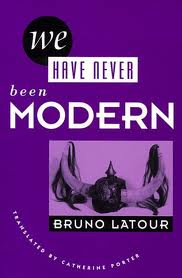
If any book has ever changed the way I think, it would be Bruno Latour's "We Have Never Been Modern". It is a complex argument with a lot of fascinating implications that philosophers are still working out.
In this book, Latour describes modernity - our contemporary way of thinking, living, and asking questions - as being founded on a particular 'constitution' or set of rules that have come to be taken for granted, but that turn out to be self-contradictory and groundless when we examine them. The reason is that we 'moderns' only think consciously about one part of the constitution at a time, and so the contradictions escape us - we believe we are actually being consistent.
Central in Latour's analysis of modernity is our attempt to separate Nature from Society. Nature stands for everything that simply is what it is, whether we would like to change it or not. Society stands for all that is human, human-made and artificial, that we might construct otherwise if we choose to. What Latour shows is that Nature and Society aren't really that easy to separate in reality, even though the moderns treat them as if they are already separate.
For example, a scientist in a laboratory claims to be seeing Nature as it is, apart from any human construction. But he can only confirm what Nature is in itself through the agreement of a community of scientists in a human-made laboratory. They construct an environment and a consensus that Nature is a particular way. This way, Nature is founded on Society. But this can be reversed. The science of Society tells us that humans can construct whatever society we like, and that this is our liberty. But in order to base her argument on something, the social scientist refers to sociological 'laws' that echo the natural 'laws' of the laboratory. Society is then ultimately founded on Nature.
We, the 'moderns', are only able to look at one of these at the time, and so we don't realize the inconsistency. In fact, Latour says, there has never actually been a clear separation between Nature and Society. But for as long as we have told ourselves that we manage to make that separation, we have remained blind to the many 'hybrid' things in the world that belie our categories. In this sense we have never been modern - for we have never actually separated Nature from Society.
Latour shows how our views of God, history, time, materiality, ideas, etc. are all connected to the modern 'constitution', and also how the questions regarding all of these are re-opened when we realize just how unsustainable is the modern way of thinking and practicing. We cannot forever keep on acting as if the separation of Nature and Society is possible, but all our modern practices are tangled up in this misconception.
After having argued that we have never been modern, Latour then has to explain what then we have actually been. In other words, he must give us an alternative way of thinking about the world. This is the basis for what has become loosely known as 'Actor-Network Theory', even though Latour himself is not too fond of that particular label.
The details of this philosophical system is a bit too complex for this post. Generally, it is used as if it simply means giving more attention to the material objects involved in human societies, but Latour's metaphysics are a bit more radical than that. While Latour's view of the world has recently been taken up by confessional atheist philosophers as a kind of 'deep' materialism, his metaphysics also invites a sacramental, trinitarian, catholic theology. In a later post, I hope to show how this is the case.
In this book, Latour describes modernity - our contemporary way of thinking, living, and asking questions - as being founded on a particular 'constitution' or set of rules that have come to be taken for granted, but that turn out to be self-contradictory and groundless when we examine them. The reason is that we 'moderns' only think consciously about one part of the constitution at a time, and so the contradictions escape us - we believe we are actually being consistent.
Central in Latour's analysis of modernity is our attempt to separate Nature from Society. Nature stands for everything that simply is what it is, whether we would like to change it or not. Society stands for all that is human, human-made and artificial, that we might construct otherwise if we choose to. What Latour shows is that Nature and Society aren't really that easy to separate in reality, even though the moderns treat them as if they are already separate.
For example, a scientist in a laboratory claims to be seeing Nature as it is, apart from any human construction. But he can only confirm what Nature is in itself through the agreement of a community of scientists in a human-made laboratory. They construct an environment and a consensus that Nature is a particular way. This way, Nature is founded on Society. But this can be reversed. The science of Society tells us that humans can construct whatever society we like, and that this is our liberty. But in order to base her argument on something, the social scientist refers to sociological 'laws' that echo the natural 'laws' of the laboratory. Society is then ultimately founded on Nature.
We, the 'moderns', are only able to look at one of these at the time, and so we don't realize the inconsistency. In fact, Latour says, there has never actually been a clear separation between Nature and Society. But for as long as we have told ourselves that we manage to make that separation, we have remained blind to the many 'hybrid' things in the world that belie our categories. In this sense we have never been modern - for we have never actually separated Nature from Society.
Latour shows how our views of God, history, time, materiality, ideas, etc. are all connected to the modern 'constitution', and also how the questions regarding all of these are re-opened when we realize just how unsustainable is the modern way of thinking and practicing. We cannot forever keep on acting as if the separation of Nature and Society is possible, but all our modern practices are tangled up in this misconception.
After having argued that we have never been modern, Latour then has to explain what then we have actually been. In other words, he must give us an alternative way of thinking about the world. This is the basis for what has become loosely known as 'Actor-Network Theory', even though Latour himself is not too fond of that particular label.
The details of this philosophical system is a bit too complex for this post. Generally, it is used as if it simply means giving more attention to the material objects involved in human societies, but Latour's metaphysics are a bit more radical than that. While Latour's view of the world has recently been taken up by confessional atheist philosophers as a kind of 'deep' materialism, his metaphysics also invites a sacramental, trinitarian, catholic theology. In a later post, I hope to show how this is the case.
Labels:
catholicism,
Latour,
modernity,
philosophy,
Readings,
sacramental
17/11/2010
The Adventure of Orthodoxy
I regularly return to Orthodoxy.
Everyone wants to be G.K. Chesterton's friend. In a debate forecast as the philosophical equivalent of ultimate wrestling, theologian John Milbank and philosopher Slavoj Zizek wasted much of their time and ink arguing over who had more support from Chesterton. Of course, if Chesterton himself was at the debate, he would turn up late, make everyone laugh, and drag Zizek and Milbank down to the pub for a pint, in the name of sanity.
For those of you who have not yet had your lives changed (into LIVES) by reading this witty, unafraid and paradoxical writer - try Orthodoxy. It will make you laugh at yourself, and your world - since when laughing at yourself, you take up less space in it - will seem larger. Then go on to Heretics, Introduction to the Book of Job, the Father Brown stories, The Everlasting Man, and his numerous published essays and poems. Enjoy.
Everyone wants to be G.K. Chesterton's friend. In a debate forecast as the philosophical equivalent of ultimate wrestling, theologian John Milbank and philosopher Slavoj Zizek wasted much of their time and ink arguing over who had more support from Chesterton. Of course, if Chesterton himself was at the debate, he would turn up late, make everyone laugh, and drag Zizek and Milbank down to the pub for a pint, in the name of sanity.
For those of you who have not yet had your lives changed (into LIVES) by reading this witty, unafraid and paradoxical writer - try Orthodoxy. It will make you laugh at yourself, and your world - since when laughing at yourself, you take up less space in it - will seem larger. Then go on to Heretics, Introduction to the Book of Job, the Father Brown stories, The Everlasting Man, and his numerous published essays and poems. Enjoy.
14/11/2010
The theology of Robin Hobb
We have long been reading Robin Hobb's tales from the Realm of the Elderlings. That is, I read, while Linda sews, knits, draws, or plays computer games (yeah, she didn't put THAT on her blog, did she?). We have finished three trilogies (Farseer, Liveship Traders, and Tawny Man), and are waiting for Hobb to finish the last book in her fourth trilogy before we embark on that.
One thing that makes Hobb's books so interesting compared to many other fantasy writers is that she has created a world where it is not given which people group or race is 'good' or 'bad'. This way she can write a trilogy from the perspective of one group, in which other peoples are portrayed as 'barbaric', while the next trilogy might be written from this very group's perspective, showing the 'barbarism' of the former group. In a world of more than five different people groups and a time-span of potentially thousands of years, she can keep writing for a while.
I am not going to recount the stories here. I only want to say that there are enough books in the world about the theological undercurrents in the works of C.S. Lewis and J.R.R. Tolkien. It is about time Robin Hobb had her following of the 'theologically interested'. Aside from more obvious 'religious' traits such as magic(s), prophesies, betrayal and reconciliation, and innocent sacrifices - common to so much fantasy literature-, her books are filled with themes such as global and ecological restoration after a cataclysmic Fall in the past, humans being destined for 'deification' (mutating into something 'higher' through the correct interaction with the world), mixed with a high regard (almost sacramental) for the ordinary life of eating, sleeping, and working.
One thing that makes Hobb's books so interesting compared to many other fantasy writers is that she has created a world where it is not given which people group or race is 'good' or 'bad'. This way she can write a trilogy from the perspective of one group, in which other peoples are portrayed as 'barbaric', while the next trilogy might be written from this very group's perspective, showing the 'barbarism' of the former group. In a world of more than five different people groups and a time-span of potentially thousands of years, she can keep writing for a while.
I am not going to recount the stories here. I only want to say that there are enough books in the world about the theological undercurrents in the works of C.S. Lewis and J.R.R. Tolkien. It is about time Robin Hobb had her following of the 'theologically interested'. Aside from more obvious 'religious' traits such as magic(s), prophesies, betrayal and reconciliation, and innocent sacrifices - common to so much fantasy literature-, her books are filled with themes such as global and ecological restoration after a cataclysmic Fall in the past, humans being destined for 'deification' (mutating into something 'higher' through the correct interaction with the world), mixed with a high regard (almost sacramental) for the ordinary life of eating, sleeping, and working.
10/11/2010
Alain Badiou: an atheist reads St. Paul
The first in a series of books I have just read that somehow inspired me, is Alain Badiou's book on St.Paul's radical philosophy and politics.
Alain Badiou is one of the contemporary philosophers who despite his announced atheism is exploring Christian doctrine for resources to meet present philosophical and political challenges. In particular, he has engaged with Christian thought as it develops through the work of St. Paul. Most of Badiou's philosophy is hard to understand, since he is often demanding an advanced understanding of mathematics (in particular Cantorian set theory) from his readers. I wish...
One could of course accuse Badiou of simply trying to shape St. Paul in the image of his own philosophy. He is certainly not the only one doing that. His project is nevertheless fascinating because of how he introduces the book to his assumed atheist readers (to whom he obviously feels he has to justify his use of Christian thought at all). Badiou himself states that there are more important distinctions to make in the contemporary world than between 'religion' and philosophy.
Our contemporary world, says Badiou, is a place where there is a homogenizing universalism on the one hand, and a kind of impotent identity politics on the other. What does this mean? On one side, a globalizing market reduces all forms of life to mere numbers on a sheet of paper, drained of any specific quality. Everything can be measured (in terms of money), and compared on the same background. On the other side, there are groups seeking recognition of their 'rights' within this global order, and trying to distinguish themselves from those who do not belong to that particular group.
Badiou claims the conditions we live under are similar to the circumstances of St. Paul, and that we have much to learn from the apostle's radical break with everything around him and his construction of a new way of thinking and living the (his) truth. On the one hand, Paul was surrounded by a Roman empire (our time's global market) that enveloped all particular identities within its geographical borders and the limits of its Greek philosophy. On the other hand, he was engaging with a Jewish community (our time's identity politics and interest groups) that sought to have their particular 'rights' recognized by the Empire, while distinguishing themselves from all the other groups through certain characteristics.
These two forms of 'universalism' always go together - in fact they re-enforce each other -, and both are false to Badiou. What he sees St. Paul doing, then, is to challenge both of these at the same time. St.Paul refuses all the available categories of the world around him ('there is no Greek nor Jew, no male nor female, etc'), and constructs 'from scratch' a completely new kind of practicing community (the Church) that is universal but not homogenizing like the empire, and time/place-specific without being based on particular qualities (showing who's 'in' or 'out') like the Jewish community.
Badiou's reading of St. Paul flies in the face of what many contemporary churches seem to be practicing. Either, the church attempts to subsume everything and everyone into itself (as if it were an Empire) - or it is fighting for its 'rights' to be recognized by the State, while constantly trying to define the criteria for being 'within' and 'outside of' its fold (as if it were just another interest group). Badiou's reading suggests none of these strategies are 'Christian' in the way St. Paul describes it.
Contemporary theologians and self-professed believers might be facing a time when atheist philosophers are prepared to do more radical theological thinking (and practicing) than themselves...
Labels:
Badiou,
philosophy,
politics,
postmodernism,
Readings,
St.Paul,
theology
Subscribe to:
Posts (Atom)