Showing posts with label modernity. Show all posts

26/03/2011

Tinkering in tongues - on liturgies badly performed

I could probably be placed squarely within the audience James K.A. Smith imagines when he is writing. Having grown up in a pentecostal church, only to spend the past decade slowly moving towards Catholicism and even (...) 'Eastern' Orthodoxy, just being aware that Smith had written this book was a challenge to my self-image. Other books by the same author had provided bridges for my 'crossing-over', is he now trying to bring me 'back' across that gap? On the one hand I want him to be right. Indeed, if one could isolate what pentecostal churches do (at least in terms of social work etc) from their own often rather studdering attempts to articulate theological rationales, that would be great. On the other hand, if Smith is right, and Pentecostalism has 'something to offer' philosophically, then it also feels a little like I would have to reconsider quite much of my own 'journey' so far. And that would be uncomfortable, I guess, and I would probably prefer to avoid that. Who likes admitting they're wrong...?

James K.A. Smith is a very good writer with a rich toolbox of anecdotes and home-made hyphenated words (I know from his blog that he is consciously honing his writing skills - probably unlike many academic writers - and the result shows). Earlier he has written on how reformed Christian philosophy might benefit from interaction with anglo-catholic 'Radical Orthodoxy', how Evangelical apologists must not simply reject all that is called 'postmodern', and how Christian education lies embedded in the 'rhythms' of embodied, habitual, and collective practices rather than in the content of the curriculum. All very bold projects, considering Smith's largely Evangelical context.

His latest work(s) draws heavily on that of Charles Taylor, in particular on the concept of the social imaginary. In short, Smith takes 'social imaginary' to mean '(big) ideas implicit in practices', which is an OK short-hand for what Taylor is speaking of. On this (phenomenological) view, meaning resides not primarily in heads as propositional thoughts, but is rather 'always-already' embedded in collective habitual bodily conducts. (Like Taylor, Smith bypasses the question of the ontological relation between practices and discourses - the main point is that these are never entirely synchronized, and that the former is more vital). Smith then introduces the idea that this 'social imaginary' resembles notions carried in the word 'liturgy': our deepest desires are directing - as well as being directed by - the embodied 'common work' a group performs together. Then he can speak of the liturgies of shopping, the liturgies of higher education, you name it. Practices we take for granted can hence be analyzed as formative of our desires, as 'cultural liturgies', which might or might not conform to 'orthodox' theological articulations.

At this point, both self-proclaimed secularists and Catholics might hesitate. Smith anticipates the critique of the former (evoking familiar 'secular' names from scholarly fields with 'post' in front of them), but seems (to me at least) to neglect the latter, who might have objections regarding this 'watering down' of the Rite to simply include every collective practice in equal measure. In any case, I am willing to go quite far with Smith down this road (as would many catholic theologians as well). Personally, I am very warm to the idea that 'culture' should be assessed in terms of liturgy, (but then) taking the Eucharistic event as fundamental to all reality. And I like Smith's academic boldness, pure and simple. But in this book problems arise even for me.

I realize that my hesitance might stem from my own background and journey. When I was a teenager in a pentecostal church, the word 'liturgy' was meant to denote empty practices done by mere habit rather than by conviction. And that, so it went, was a really bad thing (as if habits could ever be 'mere', or practices ever be 'empty'). Of course, at a certain point you have to concede that 'we also have a kind of liturgy', and then encourage the services to be 'open' for 'interruption' so that authenticity might be preserved. At a certain point I began thinking that since 'everyone has a liturgy' the difference would have to be how well-performed and comprehensive these liturgies were, and that they should be somehow comparable. So I was hoping this book would have something to say on that. Maybe my notion (now conviction) that 'high church' liturgies are simply better than pentecostal ones must be qualified?

Smith's project is to tease out the big ideas that are implicit in the embodied, habitual, collective practices of pentecostal worship, and to show that these not only beat 'modern' reductive rationalism every time (which is probably true, as far as I'm concerned - but hey, that's an easy target), but that they are closer to traditional 'orthodoxy' than pentecostal articulations of doctrine itself sometimes tend to be.

There are several issues here. One question is what Smith thinks is the relation between the meanings he discerns in the practices of 'ordinary' pentecostal worshipers, and the somewhat different meanings these 'ordinary' worshipers (or even pentecostal theologians) are articulating. Smith grants that practice and articulated theory are not always in synchrony, but does not attempt to explain their actual or ontological relation. Here stops phenomenology, so Taylor would be excused for not going further, but why does not the theologian at least attempt to connect the two?

But much more importantly, there is something revealing about Smith's choice of 'field studies':

Smith wants to 'decode' the rhythms of pentecostal worship, and does so by referring to single events, single Sunday services treated as full examples of Pentecostal worship. It is for example telling that these events as they are described could be taking place at any time of the year. There is no sense in Smith's recaps of pentecostal worship of any 'long-term' rhythm, akin to the traditional church year, with its high and low points. And this is probably accurate. Had he attempted to do the same with Roman Catholic services, he would have had to consider the service in the context of the whole church calendar, with its slow ebbs and flows of different seasons.

And why would Smith limit pentecostal 'worship' to Sunday services, when all collective habits are supposedly 'liturgical'? Doesn't the 'flat' nature of the pentecostal church year signal any 'implicit understandings'? To me, it seems this aspect of the pentecostal social imaginary is far closer to the market/individualism Smith rejects than he would want to admit. Maybe the absence of a 'thick' annual calendar structure in pentecostal worship suggests that the 'overlap' with other (ultimately contradictory) social imaginaries is more problematic than Smith allows for. Because he isolates 'pentecostal' behaviour to Sunday services. Smith actually ends up ignoring the actual complexity of embodied life patterns, and how the 'market liturgies' (to take an example) penetrates into the 'pentecostal imaginary' itself.

Smith also bypasses any comparison of the centrality of preaching in pentecostal services with that of the Eucharistic event in 'higher' liturgies. He focuses on the centrality of embodied action in pentecostal services as an implicit critique of procrustean rationalistic categories. But is not in fact the sermon the central event in the pentecostal service, rather than the bodily actions that happen before (song) or after (alter call) it is delivered? While many elements in pentecostal worship emphasize the goodness of human embodiment, the very structural centrality of the sermon (as well as the architectural centrality of the pulpit) still imply a heavy leaning towards disembodied and 'unmediated' transmission of abstract and unchanging content.

If one compared the sermon as the central event in a pentecostal service with the Eucharist and sharing of bread and wine as the central event in a service in a(ny!) 'higher' church tradition, what would be the difference? My hunch is that such a comparative study might  reveal two very different 'ideal types' of the church (and here we might invoke catholic thinker Charles Taylor for support, this time against Smith) implicit in the two performances.

In the pentecostal service, then, the implied social imaginary would perhaps be one where fundamentally atomistic individuals come together for mutual benefit, centered on the transmission of a 'pure' message that they are then to 'apply' after hearing it. As the message "moves from our heads to our hearts", it can also 'seep into' the world outside. This is very akin to what Charles Taylor calls the modern social imaginary. For all its emphasis on embodied movements, it remains strictly modern as much as the market that Smith wants to provide an alternative for.

In the 'high' church service, the implication is that one single yet universal (!) event provides the eternal foundation for all other events in reality, including the individuals 'emerging' from its relational centre. The ontological 'archetype' implicit in the Eucharistic rite is one where relationality as such is fundamental and originary, and where all events (such as individuals) are ultimately such only by a kind of sharing in one single event - that of the Incarnation.

If we were to compare church years (longer term rhythms), or architectural organization, or what is the high point in the liturgical 'narration' (sermon or Eucharist), I still feel that Pentecostalism is 'modern', far too 'modern'. 

I have long been on a kind of journey from Pentecostalism to something kind of more 'catholic'. But I am not really more 'catholic' than 'pentecostal'. I don't really know what it would be right to call myself. My theory and practice are still out of sync, though I believe I am slowly catching up with myself. Smith's book unfortunately (because I was actually hoping a little - maybe that's why I'm a bit touchy) provides no answer to what for me was the question spurring my journey:

It's liturgy all right, but is it well-performed?

24/11/2010

Latour and modernity

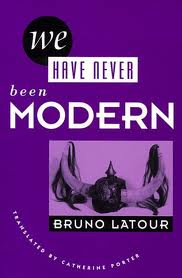
If any book has ever changed the way I think, it would be Bruno Latour's "We Have Never Been Modern". It is a complex argument with a lot of fascinating implications that philosophers are still working out.

In this book, Latour describes modernity - our contemporary way of thinking, living, and asking questions - as being founded on a particular 'constitution' or set of rules that have come to be taken for granted, but that turn out to be self-contradictory and groundless when we examine them. The reason is that we 'moderns' only think consciously about one part of the constitution at a time, and so the contradictions escape us - we believe we are actually being consistent.

Central in Latour's analysis of modernity is our attempt to separate Nature from Society. Nature stands for everything that simply is what it is, whether we would like to change it or not. Society stands for all that is human, human-made and artificial, that we might construct otherwise if we choose to. What Latour shows is that Nature and Society aren't really that easy to separate in reality, even though the moderns treat them as if they are already separate.

For example, a scientist in a laboratory claims to be seeing Nature as it is, apart from any human construction. But he can only confirm what Nature is in itself through the agreement of a community of scientists in a human-made laboratory. They construct an environment and a consensus that Nature is a particular way. This way, Nature is founded on Society. But this can be reversed. The science of Society tells us that humans can construct whatever society we like, and that this is our liberty. But in order to base her argument on something, the social scientist refers to sociological 'laws' that echo the natural 'laws' of the laboratory. Society is then ultimately founded on Nature.

We, the 'moderns', are only able to look at one of these at the time, and so we don't realize the inconsistency. In fact, Latour says, there has never actually been a clear separation between Nature and Society. But for as long as we have told ourselves that we manage to make that separation, we have remained blind to the many 'hybrid' things in the world that belie our categories. In this sense we have never been modern - for we have never actually separated Nature from Society.

Latour shows how our views of God, history, time, materiality, ideas, etc. are all connected to the modern 'constitution', and also how the questions regarding all of these are re-opened when we realize just how unsustainable is the modern way of thinking and practicing. We cannot forever keep on acting as if the separation of Nature and Society is possible, but all our modern practices are tangled up in this misconception.

After having argued that we have never been modern, Latour then has to explain what then we have actually been. In other words, he must give us an alternative way of thinking about the world. This is the basis for what has become loosely known as 'Actor-Network Theory', even though Latour himself is not too fond of that particular label.

The details of this philosophical system is a bit too complex for this post. Generally, it is used as if it simply means giving more attention to the material objects involved in human societies, but Latour's metaphysics are a bit more radical than that. While Latour's view of the world has recently been taken up by confessional atheist philosophers as a kind of 'deep' materialism, his metaphysics also invites a sacramental, trinitarian, catholic theology. In a later post, I hope to show how this is the case.

05/11/2010

A crash course in contemporary thinking...

...with no name-dropping and as free of technical vocabulary as possible.

(If any professional philosophers read this, I apologize sincerely. Then, on the other hand, why are you, a professional philosopher, reading this blog?)

Philosophy books can be very intimidating for some of us. The vocabulary can be so specialized, and just when you think you have understood a sentence, the next sentence proves you wrong. So here is a quick crash course in contemporary thinking, without any pretentious dropping of French-sounding names, no assumptions about how updated you should be on philosophical debates or terms such as ‘Immanence’, and no implication that you have be a scholar do some good thinking. That does not mean that it will be easy to understand the implications of everything here, this is a crash course after all. There will also be no real answers here, only a way of asking questions, of posing problems, of thinking. That’s kind of the point.

THE big question is 'What is Reality?'


Imagine Reality as a circle, outside of which is nothing. Everything that is, is inside this circle. That seems simple enough, but remember that even lies, misunderstandings, and false ideas cannot be outside the circle. In Reality, there must be a place for the false as well, or we would have to draw two circles. But false ideas do not exist in a parallel reality, but in this one. Therefore, everything that is, is included in Reality, even if its nature is ‘false’.

Enter you, the philosopher.

(Model 1)


Here you are, looking at Reality, tasting it, smelling, feeling, hearing it, thinking of it. What is Reality like? How can you describe it? For many philosophers these are the important questions. How can we know anything about Reality, what are the limits to our understanding, and so on.

But for others another question becomes important: Isn’t it true that you can’t describe Reality as it is anyway, that you only see it from your particular perspective? It’s like you are wearing glasses that are coloured, and so Reality seems to have that colour. Reality seems to be a particular way, but really this is only because of your perspective. And no perspective is perfect. So how then can you see further than your own perspective?

(Model 2)
Some philosophers like the first model of the philosopher looking at Reality, whereas others really get into model two, and the critique of perspectives. The latter have sometimes called the former “modern” and themselves “postmodern”, since they see themselves as coming ‘after’ (post) the ‘moderns’, somehow being aware of (and maybe avoiding) the mistakes of their forerunners. The ‘moderns’ would sometimes respond by calling the ‘postmoderns’ irrational (that they weren’t really all that clever) or relativists (that a result of their thinking would be that anything is equally OK) or inconsistent (that their actual lives could never match up to their theories, since the phrase ‘everything is relative’ could not itself be relative).

I think it is fair to say that neither side represented the other in a very generous way.

But there is another question that arises from both model 1 and 2, that has become more important to some contemporary thinkers.


The model shows the philosopher standing outside of Reality looking in. If so, then why don’t we draw 6 billion little people looking ‘into’ Reality? But the problem here is, of course, that for the philosopher – or for you, for that matter – all other people are part of the Reality she/you is trying to explain. All other people belong inside the big circle, and you look ‘in’ on them. But if they are included in the circle, then the philosopher herself should also be included. If nothing that is, is outside of Reality, then the philosopher and all her thoughts must also be included within it.

(Model 3)
 
This is where much contemporary philosophy takes its starting point (I just call it contemporary, because it isn’t really ‘modern’ or ‘postmodern’ – it doesn’t call itself anything). The thinker, her thoughts, and Reality are parts or aspects of the same ‘thing’ – so what is this thing? How do differences between the thinker and the rest of Reality emerge? How ‘solid’ are the boundaries between different things in Reality? How ‘solid’ are the boundaries of Reality itself? How do new things come into being? What is change? What is that thing we call ‘thought’, and what is its relation to the rest of Reality?

This can make some contemporary philosophy books seem quite strange. While trying to answer the question of what Reality is, the philosopher’s is at the same time trying to fit her own thinking itself (not only her ‘finished’ thoughts, but the process of thinking where more or less fully formed thoughts emerge) into the picture – the book she is writing must be included in the Reality it describes. It is like stories that have stories within them – imagine that the bigger story was to be fitted into the smaller story that is within the bigger story…that’s right, it gets complex and strange.

A few notes on the 'God question':

For those particularly interested (and not turned off by the above simplifications), I want to suggest how the ‘God question’ fits into the three models outlined above.

In the first model, God often figures in two places at once: On the one hand, God is a kind of external assurance that the philosopher will be able to understand Reality as it is, or approximately so. As she is looking at Reality, God hovers above her as the Designer of Reality, who makes sure its laws and principles remain stable and universal. On the other hand, God is a ‘still voice within’, nearer the self than rationality, emotions or any conscious idea. God is either 'out there' to be proved, or 'within' to be experienced. Behind all ‘postmodern’ perspectives, the God of the ‘moderns’ always guarantees the unity and essential stability of Reality, whether from far ‘outside’ or from deep ‘inside’.

In the second model, God often figures as the Other perspective, the Voice that interrupts your story of what Reality is. There is no access to any Reality outside of perspectives, no shortcuts through the known purposes of a grand Designer. Here, God is that nudging sense that all is not complete, the whispering Voice of the voice-less outcasts of any seemingly flawless description. In the face of all ‘modern’ claims of underlying structures and stabilities, the God of the ‘postmoderns’ always interrupts the flow of anything that seemed complete and ‘closed’.

In the third model, the ‘God question’ becomes paradoxical and loses much of its sting altogether. Asking whether God exists or not is very much like asking whether God (whatever is meant by the term) is included in Reality. Now, for Christian theology (since it is here the ‘God question’ is most often debated) this is not really a question that makes sense. On the one hand, God is seen as Creator of the world, and so not a simple part of that world, so it seems the answer should be ‘no’. But, if one answers ‘no, God should not be included in Reality’, this amounts to saying that God does not exist, even while affirming that God is Creator. On the other hand, if one answers ‘yes, God should be included in Reality’, this seems to align God with creation, reducing God to merely one of many things that are ‘out there’ in the world.

In this third model the question whether God exists or not, is a question that makes no sense. What some do, then, is to show that Christian theology has a long history of distinguishing between the ‘existence’ of creation and the ‘Being’ of God. Created things ‘exist’ only by participating in the ‘Being’ of God, they say. Therefore, to affirm that God ‘exists’, is actually technically wrong from a theological point of view. The answer to the ‘God question’ in the third model, is neither ‘yes’ nor ‘no’, but something entirely different than the available alternatives. In a sense it is the question itself that is wrong, since it only makes sense if it first ignores theology – and then demands a theological answer. On this perspective, both model 1 and 2 ask the wrong question. In the third model, then, the question of God is thrown wide open, even though many ‘moderns’ and ‘postmoderns’ do not like it, and so are trying to shut it down again.